
Ceasefire Collapse: The Hormuz Trap the Establishment Hoped You'd Ignore
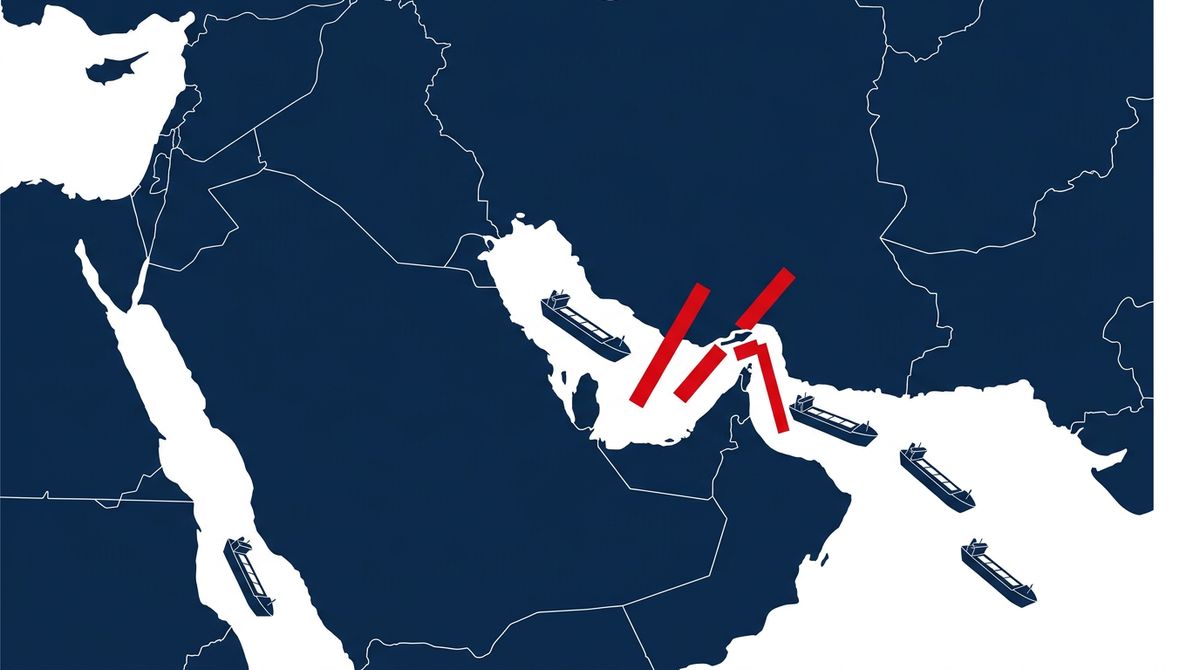
Every empire displays systemic decay within its industrial and maritime architecture long before the currency confirms it. Strategic choke points and international accords crack first.
The global balance sheet collapses second. We are witnessing the opening act of this macroeconomic repricing today. Yet, most capital owners remain entirely paralyzed by financial blindness.
Washington and Tehran signed a Memorandum of Understanding on June 29, 2026. It promised an immediate halt to hostilities, unhindered passage through the Strait of Hormuz, and a 60-day window for diplomatic engagement.
The establishment sold you a narrative of long-term stability. Check your calendar. By July 8, 2026, that truce was a smoldering footnote. That is exactly nine days of corporate peace before the geopolitical ledger violently reset.
Strip away the noise. What just occurred in the Persian Gulf is not an isolated flare-up. It is a recurring structural trap engineered to drain fiat purchasing power, disrupt collateral chains, and punish unhedged capital.
I. The Tactical Exchange: What Actually Happened in the Strait
The mainstream narrative is already buried in bureaucratic spin and defensive posturing. Let the institutional record speak with clinical precision:
- The Shipping Strikes: Iran executed targeted drone and projectile strikes against three commercial tankers transiting near the Omani coast: the Marshall Islands-flagged Qatari LNG carrier M/T Al Rekayyat, the Saudi Arabia-flagged M/T Wedyan, and the Liberian-flagged M/T Cyprus Prosperity.
- The American Offensive: Shifting from defensive posturing to an explicit offensive mandate, U.S. Central Command (CENTCOM) executed precision strikes on over 80 targets across Iran’s Hormozgan province and the port of Mahshahr. The strikes neutralized coastal radar installations, command networks, surface-to-air missile nodes, and more than 60 IRGC small boats.
- The Iranian Retaliation: The Islamic Revolutionary Guard Corps (IRGC) retaliated by targeting 85 U.S. military sites across Bahrain and Kuwait, specifically striking infrastructure near Port Salman, the U.S. Fifth Fleet naval base, and Ali Salem Airbase. Kuwaiti authorities confirmed the impact of two ballistic missiles and 13 drones on their territory.
- The Financial Sanctions: The U.S. Department of the Treasury immediately rescinded the 60-day oil export waivers granted under the June 29 accord. All active Iranian crude revenues have been frozen inside blocked, interest-bearing accounts.
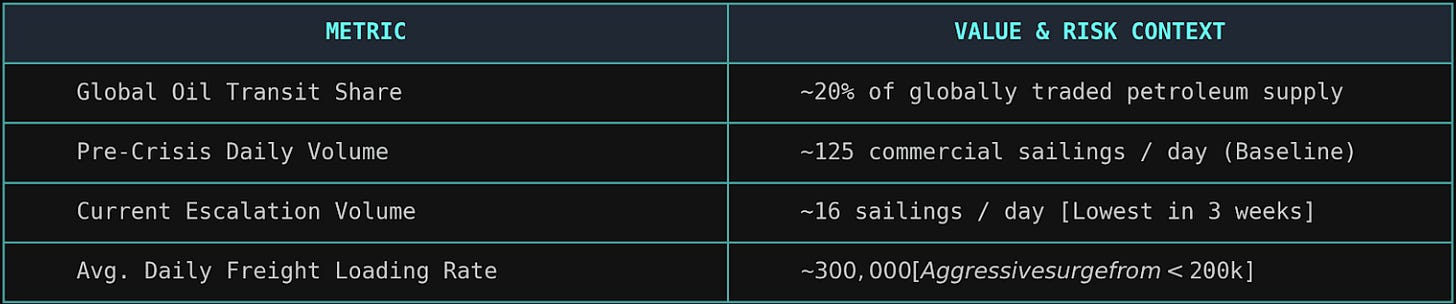
Global Traded Oil Through Chokepoint: ~20%
Pre-Crisis Transit Volume:            ~125 sailings per day
Current Escallation Volume:           ~16 sailings per day (Lowest in 3 weeks)
Average Daily Freight Loading Rate:   Increased to ~$300,000 (From <$200,000)
U.S. President Donald Trump, speaking at the NATO summit in Ankara, declared the ceasefire permanently finished, dismissing future diplomatic overtures as a waste of time. Concurrently, the EU Aviation Safety Agency issued a directive forcing commercial airlines to completely bypass Iranian, Iraqi, and Lebanese airspace through August 31. NATO leadership labeled the escalation “absolutely necessary.”
The math remains absolute. The Strait of Hormuz controls the transit of roughly 20 percent of globally traded petroleum. When this corridor transitions from “contested” to an active war zone, the resulting supply shock is not an abstract model—it is an immediate risk to your capital stack.
II. The Market Response: Reading the Stagflation Signals
Hours after the collapse of the MoU became undeniable, global markets delivered an uncompromised verdict.
The financial establishment will tell you this volatility is a transitory overreaction. My three decades in the archives confirm that the macro script does not change.
In 1990, when the Iraqi invasion of Kuwait compromised Gulf shipping lanes, Brent crude doubled within ninety days. The S&P 500 corrected 19.9%, dragging the broader economy into an eight-month structural recession. In 2019, a singular drone strike on Saudi Aramco’s Abqaiq processing facility induced a 15% spike in oil prices in a single session. Today, the entire maritime infrastructure of the Strait is structurally broken.
The immediate removal of 1.5 million barrels per day of Iranian export volume cannot be easily absorbed. OPEC+ spare capacity remains highly restricted, and domestic shale infrastructure requires quarters, not days, to scale operational output.
The bond market is flashing an ominous signal: yields are climbing in tandem with a strengthening U.S. dollar. This is the explicit fingerprint of stagflation—the exact macroeconomic environment where a standard 60/40 portfolio is systematically liquidated. The core assumption that sovereign bonds function as a structural hedge against equity drawdowns dies in a supply-side inflation shock.
III. The Geopolitical Architecture: Why the Tanker War Matrix Has Mutated
Every generation of Wall Street analysts presumes its crisis is entirely unique. The historical record tells a more structured story.
The weaponization of the Strait of Hormuz has deep cyclical precedents. During the Iran-Iraq War of the 1980s, the “Tanker War” phase witnessed over 400 commercial hull attacks, sending maritime insurance premiums skyrocketing and forcing the deployment of Operation Earnest Will to convoy merchant fleets through the corridor.
Today, Tehran is executing a modern adaptation of that strategy: mining the chokepoint and declaring that any commercial vessel refusing to follow state-mandated transit corridors faces immediate destruction.
However, a fundamental structural shift makes the 2026 iteration significantly more hazardous:
In the 1980s, the United States functioned as a external stabilizer guarding international shipping lanes. Today, the United States is a direct combatant.
This macro conflict initiated on February 28, 2026, following joint strikes that targeted Iran’s senior leadership structure. This is no longer a localized proxy engagement. It is a direct war between the world’s dominant military apparatus and the sovereign state that physically controls the global economy’s primary energy valve.
The IRGC’s successful projectile strikes on American military installations within Bahrain and Kuwait confirm that U.S. logistical infrastructure inside allied Gulf states is now fully compromised. The post-WWII security pact that guaranteed petrodollar stability across the Middle East is taking direct, unhedged fire.
IV. The Sovereign Blueprint: Capital Preservation When Chokepoints Collapse
I do not operate on speculative predictions. I build defensive positions engineered to survive institutional systemic failure. When global supply chains fracture, capital preservation demands a clinical pivot away from paper liabilities.
- Physical Gold as the Base Layer: Do not be deceived by the initial 1% margin-call drawdown. Historically, gold declines briefly during the opening hours of a major geopolitical shock as institutional funds liquidate liquid assets to meet equity margin demands. Following the 1990 Gulf War and the 2022 Ukraine invasion, physical gold executed massive structural rallies as energy-driven inflation eroded fiat currency values. The macro case for gold has never been more absolute.
- Monetize Implied Volatility via Energy Majors: The 6% surge in Brent crude is simply the baseline. Rather than speculating on raw futures contracts, allocate toward integrated energy majors with robust downstream processing assets. Utilizing covered call architectures allows you to capture expanding options premium driven by surging implied volatility, creating immediate cash flow while capping downside risk.
- Isolate Capital via Cryptographic Protocols: Bitcoin, maintained strictly as a sovereign reserve asset under absolute personal custody, fulfills its primary structural mandate: a non-state, seizure-proof store of wealth completely independent of the petrodollar clearing network or Eurozone bank solvency. When U.S. bases in the Gulf face direct missile strikes, counterparty risk across the legacy banking system escalates dramatically.
- Execute International Asset Insulation: When global shipping lanes become active conflict zones and sovereign alliances fracture, maintaining 100% of your capital stacks within a single national jurisdiction is an unacceptable concentration risk. Accelerate the deployment of robust offshore trust structures across independent jurisdictions to shield your generational wealth from impending capital controls and emergency fiscal extractions.
The establishment continuously markets the illusion of short-term stability. The historical archive records the inevitable monetary debasement that follows every major structural collapse.
The Strait of Hormuz has been converted into a geopolitical weapon. The ceasefire is officially dead. Every investment portfolio constructed on the assumption of cheap energy and frictionless globalization is being tested under conditions most modern allocators are entirely unequipped to navigate.
The math remains absolute. Position your capital stack now.
Comments ()