
Europe's Sanctions Theater: What the 21st Package Reveals About Capital Risk
Today, July 13, 2026, EU foreign ministers gather in Brussels to adopt the twenty-first sanctions package against Russia.
Let that number sink in: twenty-one.
In asset management, if you have to patch a leaky pipe twenty-one times, it means you don’t have a patch problem—you have a structural failure. Needing a 21st round is an open admission that the first twenty failed to seal the perimeter.
Lately, some readers have noted that geopolitical analyses sound overly complex but offer very little practical substance. Let’s fix that right now. This is not an essay on ethics or international law. This is a cold audit of how political exhaustion in Europe directly exposes your capital stack to structural energy shocks and unpriced infrastructure risks.
I. The Anatomy of Compromise: What Round 21 Actually Solves (Nothing)
The official press releases follow a familiar script. French Foreign Minister Jean-Noël Barrot claims this round will decisively drain Russia’s energy liquidity. European Commission President Ursula von der Leyen markets it as a tightening of the screws.
The institutional ledger tells a completely different story. The text arriving on the desks in Brussels today has been systematically hollowed out by member states protecting their own domestic margins:
- Oligarch Exemptions: Patriarch Kirill and Lukoil founder Vagit Alekperov were quietly removed from the exclusion lists at the direct request of Bulgaria and Italy. When hitting a primary energy oligarch threatens domestic supply lines, Western capitals choose comfort over containment.
- The Maritime Loophole: Greece, Cyprus, and Malta successfully neutralized aggressive restrictions on Russian liquefied natural gas (LNG) and tanker fleets. Four years into this conflict, the Mediterranean shipping lobby still prioritizes transit fees over a total energy blockade.
- The Supply Chain Dilution: Proposed entry bans on former military personnel were watered down by France and Italy, while essential fish and cod import restrictions were discarded by Germany and the Netherlands to prevent domestic food inflation.
The macro takeaway is absolute. The G7-mandated oil price cap—currently set at a restrictive $44.10 per barrel—is being renewed for six months simply because it is the only mechanism Brussels can pass without triggering a veto.
The rest of the package is pure political theater. Paper blockades do not alter energy prices, repair broken supply chains, or protect your capital. They merely enrich the shadow brokers who navigate the gaps.
II. The Infrastructure War: The Threat Wall Street Is Ignoring
While European ministers debate import quotas on fish, a far more dangerous kinetic shift is materializing beneath the surface. The conflict has migrated from geographic borders straight into the digital architecture of Western commerce.
Today, Paris formally summoned the Russian envoy following a sweeping, FSB-traced cyber-sabotage campaign aimed at French public networks. Last week, Italy expelled two military attachés and arrested legacy intelligence officers for selling state secrets to Moscow.
This is no longer a collection of isolated incidents. The chronological data paints an undeniable picture of escalating operational risk:
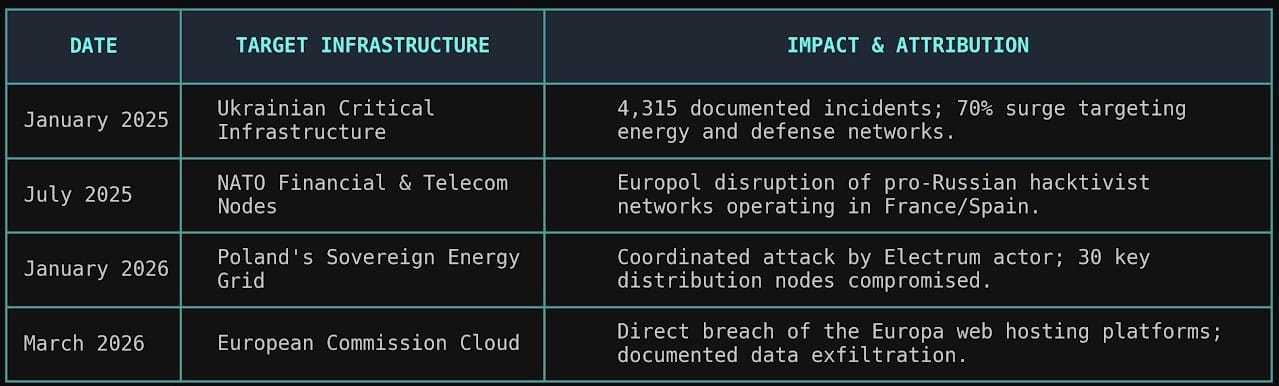
Why this matters to your money:
The financial establishment treats cyber risk as a tech-sector footnote or a defense topic. That is a critical error.
The digital networks under attack—Poland’s grid, Belgium’s telecoms, the EU’s cloud systems—are the literal rails that your wealth rides on. A successful systemic strike on European utility infrastructure doesn’t just make the evening news; it instantly spikes European gas benchmarks (TTF), freezes manufacturing output, and halts automated clearing houses.
As paper sanctions grow weaker, cyber infrastructure attacks are growing stronger. If your portfolio relies on standard European index funds, you are holding unhedged exposure to physical delivery failures.
III. The Energy Illusion: Changing the Invoice, Not the Supplier
The structural flaw that Brussels cannot sanction away is simple: Europe never cured its reliance on foreign energy; it simply rerouted the logistics.
Pipeline gas from the east was substituted with global LNG shipments—often sourced from the exact same extraction fields, routed through third-party flags of convenience, and offloaded at European maritime terminals.
Baseline European Gas Price (TTF):           Permanently Volatile (€25 - €340/MWh)
Shadow Tanker Fleet Operations:              Expanded by >40% to Bypass $44.10 Cap
EU Inbound Shipments of Russian LNG:         Increased in Select 2025 Quarters
Because Western Europe failed to secure long-term, structurally sovereign energy alternatives, the Title Transfer Facility (TTF) benchmark remains highly volatile.
Any real-world disruption—whether a pipeline maintenance dispute or a cyber-attack on a regional grid—triggers immediate margin calls across the European industrial complex.
IV. The Fiduciary Blueprint: Actionable Wealth Protection
Let’s deliver the exact utility that readers felt was missing from prior briefings. If the post-Cold War institutional framework is fraying, sitting passively in a standard 60/40 paper portfolio is a strategy for guaranteed wealth dilution.
Here is the exact blueprint required to insulate capital from Europe’s systemic decay:
- De-Risk From European Industrial and Financial Credit: Reduce concentrated exposure to equity segments that rely on cheap, frictionless European energy grids or centralized Eurozone clearing networks. The dividend yields offered by these legacy enterprises fail to compensate for the underlying infrastructure vulnerabilities.
- Isolate Capital Globally via Invariant Assets: Allocate a definitive percentage of your wealth stack into assets that carry zero counterparty liability and cannot be manipulated by emergency Brussels decrees. Physical gold, held entirely outside the legacy commercial banking perimeter, and Bitcoin maintained strictly in absolute self-custody, function as non-state monetary exit hatches.
- Pivot Energy Allocations to Sovereign Geographies: Monetize the global energy friction by moving capital out of vulnerable European utility hubs and into North American upstream infrastructure, Gulf Coast LNG export terminals, and invariant pipeline royalty streams operating within stable, domestic legal frameworks.
- Deploy Systematic Covered Call Structures: Geopolitical volatility expands options premiums. Instead of attempting to time market tops or bottoms, writing covered calls against your resilient equity holdings allows you to harvest predictable, immediate cash flow while establishing hard exit thresholds.
The twenty-first sanctions package is not a demonstration of Western alignment; it is a monument to institutional exhaustion. The real conflict has moved to the energy grids and digital plumbing of the financial system.
The math remains absolute. Stop trading the performative headlines, insulate your core assets from systemic infrastructure risk, and build absolute autonomy. The machinery will not preserve your wealth for you.
Comments ()