
Medicare's Subsidy Termination Is a Systemic Signal — Not a Policy Footnote
On Tuesday, the Centers for Medicare & Medicaid Services (CMS) quietly confirmed what historical archives have proven for decades: government financial backstops are never permanent safety nets. They are temporary holding actions. When the program expires, the full bill lands squarely on household balance sheets.
The Medicare Part D Premium Stabilization Demonstration cost taxpayers $9.8 billion over two years, artificially shielding roughly 25 million Americans from the true cost of prescription drug coverage. Now, Washington is killing the program a full year early.
CMS Administrator Dr. Mehmet Oz claims the real-world impact will be minimal. The government’s own audit data tells a radically different story.
Strip away the political spin.
Lately, several readers have rightly noted that macro commentary often hides behind academic jargon without delivering a clear, practical message. Let's fix that today.
The core message of this briefing is simple: State subsidies do not lower real costs—they temporarily hide them while inflating systemic liabilities. When Washington abruptly pulls a $9.8 billion healthcare cushion, middle-class capital absorbs the hit through higher premiums, reduced plan choices, and squeezed corporate margins. To protect your wealth, you must audit household healthcare exposure, harvest options yield to offset price inflation, and anchor your reserves in hard, non-state assets.
If you rely on Medicare for your healthcare…
A major change is coming.
This hasn't been widely reported, but...
You could even lose coverage.
See this important news here now.
P.S. There are 3 steps every older American should do today to protect yourself from this major change to Medicare.
I. The Anatomy of a Temporary Backstop
To understand why this decision impacts your portfolio, we must look at how this backstop was built.
In 2022, the Inflation Reduction Act (IRA) redesigned Medicare Part D drug benefits, imposing a $2,000 annual out-of-pocket cap for seniors starting in 2025. While promoted as consumer relief, the law forced private insurance carriers to absorb a vastly larger share of catastrophic drug costs.
Insurance carriers responded predictably: they prepared to raise monthly premiums sharply to offset squeezed margins. A February 2026 Government Accountability Office (GAO) report confirmed that monthly premiums would have nearly doubled on average in 2025 for seniors staying in their existing plans without intervention.
Rather than fixing the underlying cost structure, federal officials launched a "demonstration program" that funneled billions directly to insurers:
- 2025 Federal Intervention: Reduced average Part D monthly premiums by $26 per month, capping plan-level increases at $35.
- 2026 Federal Intervention: Reduced average monthly premiums by $16 per month, capping increases at $50.
- Total Taxpayer Cost: $9.8 billion in direct federal outlays over a two-year span ($3.6 billion allocated in 2026 alone).
CMS officially announced it will not extend the program into 2027. Dr. Oz stated that insurers now have "sufficient experience" with the IRA market structure to operate without a federal cushion.
In federal policy, "sufficient experience" is standard code for a simple reality: the treasury can no longer justify the outlay, and the liability is being transferred back to the private sector.
While CMS published a baseline Part D premium floor of $41.33 for 2027 (up from $38.99 in 2026), true plan-level premiums—the actual bills seniors pay—will be significantly higher. Independent analysts at KFF warn that beneficiaries face some of the largest single-year premium spikes in the history of the Part D program when final plan details drop this September.
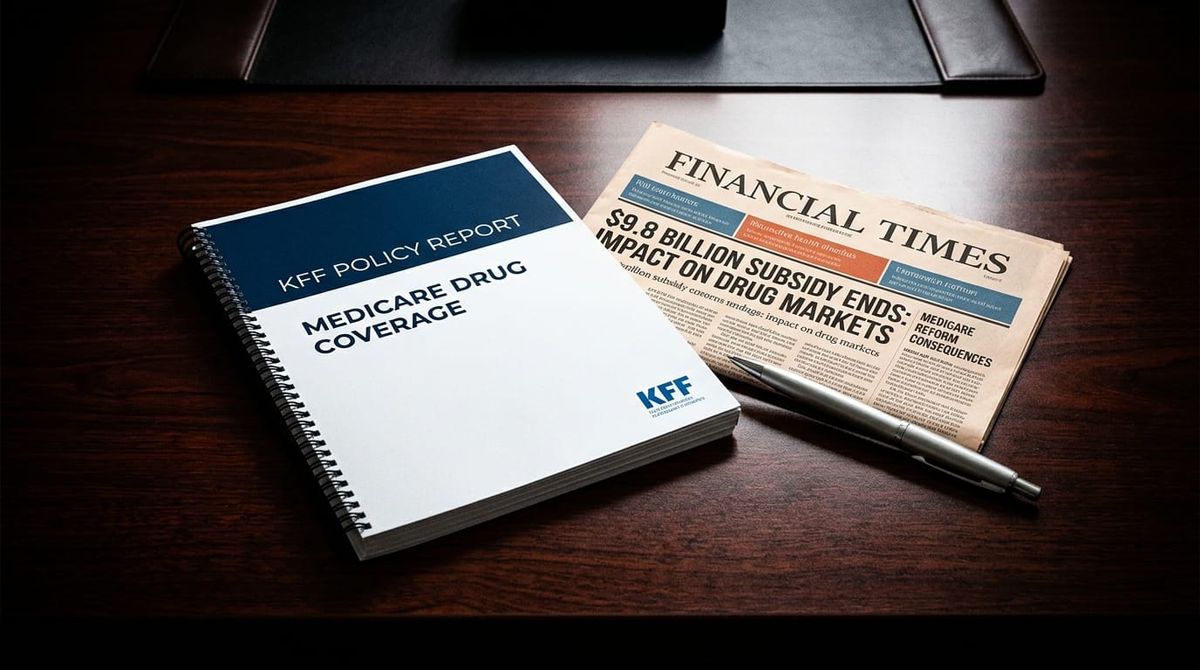
The cameras were locked on Trump...
Almost nobody noticed what was sitting on his desk.
According to this presentation...
That document may have marked the beginning of America's biggest economic shift in decades.
II. The Insurer Subsidy Machine: Follow the $3.6 Billion
A core myth in public finance suggests that healthcare subsidies directly benefit patients. In practice, subsidies flow to institutional middlemen—insurance conglomerates operating on guaranteed government cash flows.
The Part D demonstration was an institutional cash transfer. In 2026, the $3.6 billion federal allocation went directly to insurance carriers running standalone prescription drug plans (PDPs). The government paid insurers an average top-up of $16 per member each month to keep published consumer premiums at an artificial average of $36.
A senior White House official admitted to reporters that federal subsidies "gave insurers an incentive to inflate baseline premiums because the government absorbed the excess cost." This behavior mirrors every subsidized sector in financial history—from agricultural price supports in the 1930s to federally guaranteed mortgages in the 2000s.
             MEDICARE PART D PREMIUM STRUCTURE & COST SHIFT

2024 Baseline Standalone Premium (Pre-Demo):   $43.00 / Month Average
2026 Subsidized Consumer Premium:              $36.00 / Month Average
2026 Actual Cost (Consumer + Federal Top-Up):  $52.00 / Month Average ($36 + $16)
2027 Published Base Premium Floor:            $41.33 / Month (Excludes Plan Markup)
Alternative Option (Medicare Advantage Drug):  $8.00 / Month Average
Killing the subsidy accomplishes a broader structural shift: it accelerates the migration of seniors out of traditional, fee-for-service Medicare and into private Medicare Advantage (MA) plans.
With standalone drug plan premiums surging, the $8 average monthly drug cost inside Medicare Advantage plans becomes an irresistible financial magnet. However, that lower monthly price comes with strict network limitations, prior-authorization bottlenecks, and reduced choice.
Systemic incentives behave predictably: when holding a legacy position becomes too expensive, participants are squeezed directly into managed institutional frameworks.
III. The Deeper Signal: Imperial Triage and Innovation Decay
The termination of Part D subsidies occurs alongside secondary cost-containment efforts, including Most Favored Nation (MFN) drug pricing mandates aimed at capping domestic pharmaceutical prices to foreign benchmarks.
A University of Chicago policy study released this week outlines the math behind aggressive price controls:
- Revenue Impact: U.S. pharmaceutical revenues are projected to decline by 49%, driving a 31% drop in global industry revenues.
- R&D Contraction: Domestic drug research and development spending is forecast to collapse by 48%.
- Long-Term Pipeline Reduction: Lower R&D allocation means fewer breakthrough treatments enter clinical trials, resulting in an estimated loss of 516 million life-years globally over the next two decades.
You cannot force price caps on manufacturers, eliminate premium subsidies for consumers, and expect the quality or availability of care to remain unchanged. The underlying balance sheet cannot support it.
For investors, this creates a dual squeeze:
- Biotech & Pharma Equities: Mid-cap pharmaceutical firms dependent on U.S. commercial revenues face severe margin compression that standard forward-earnings models have not priced.
- Household Budgets: Individual investors relying on fixed-income yields face higher out-of-pocket medical bills precisely as corporate dividend growth slows across squeezed health sectors.
IV. The Sovereign Blueprint: Capital Preservation in a Shrinking System
When sovereign governments shed liabilities to manage structural deficits, trusting state backstops to preserve your purchasing power is a failing strategy.
Here is your practical, step-by-step blueprint to protect your capital stack:
1. Audit Household Healthcare Exposure Before Open Enrollment
Do not rely on early political statements promising modest premium increases. Open enrollment runs from October 15 through December 7, 2026. When CMS releases raw plan-level data in late September, audit your family's coverage directly at CMS.gov. Calculate the total cost—including deductibles, copays, and tier shifts—rather than relying on headline premium figures.
2. Evaluate the Hidden Trade-Offs of Medicare Advantage
If premium hikes tempt you to switch from traditional Medicare to Medicare Advantage, weigh the hidden structural costs. While MA plans offer lower upfront premiums, they restrict provider networks and require formal prior-authorizations for specialized procedures. For a sovereign individual, flexibility and autonomy are critical assets that should not be surrendered lightly.
3. Harvest Options Income to Offset Healthcare Inflation
Medical cost inflation historically outpaces headline CPI. To offset rising monthly out-of-pocket expenses without liquidating core holdings, deploy systematic covered call strategies on high-quality, dividend-paying equities. Generating consistent option premium provides an immediate cash-flow buffer to absorb rising household overhead.
4. Anchor Core Reserves in Invariant, Non-State Assets
Insulate your primary wealth from currency debasement and healthcare cost inflation by holding assets that operate completely outside federal budget adjustments:
- Physical Gold: Kept in private vault storage outside the commercial banking grid as an unencumbered monetary hedge.
- Self-Custody Bitcoin: Maintained in cold storage hardware as a rules-based monetary asset with a hard-coded supply limit of 21 million coins.
- Productive Real Estate: Debt-free agricultural or commercial land generating local, tangible rental or material yield.
5. Invest Direct Capital into Personal Health Capital
The most efficient way to defeat a predatory healthcare structure is to minimize your operational contact with it. Direct capital into metabolic health, preventative diagnostics, physical conditioning, and high-quality nutrition. Reducing your dependency on ongoing prescription maintenance eliminates a major long-term financial liability.
"State subsidies never eliminate costs; they merely delay the invoice and add an administrative fee. True capital preservation begins when you build your own financial and physical backstop."
The $9.8 billion federal cushion is gone. Twenty-five million Americans will confront the true cost of drug coverage when open enrollment opens this autumn.
Look past headline promises, audit your exposure, harvest options yield, and anchor your wealth stack in hard assets.
The math remains absolute. Position your capital stack accordingly.