
South Korea unveils $576 billion semiconductor mega-project.
Every empire displays systemic decay within its industrial architecture long before the currency confirms it. State-directed capital interventions crack first.
The corporate balance sheet collapses second. We are witnessing the opening act of this macroeconomic repricing today. Yet, most capital owners remain entirely paralyzed by financial blindness.
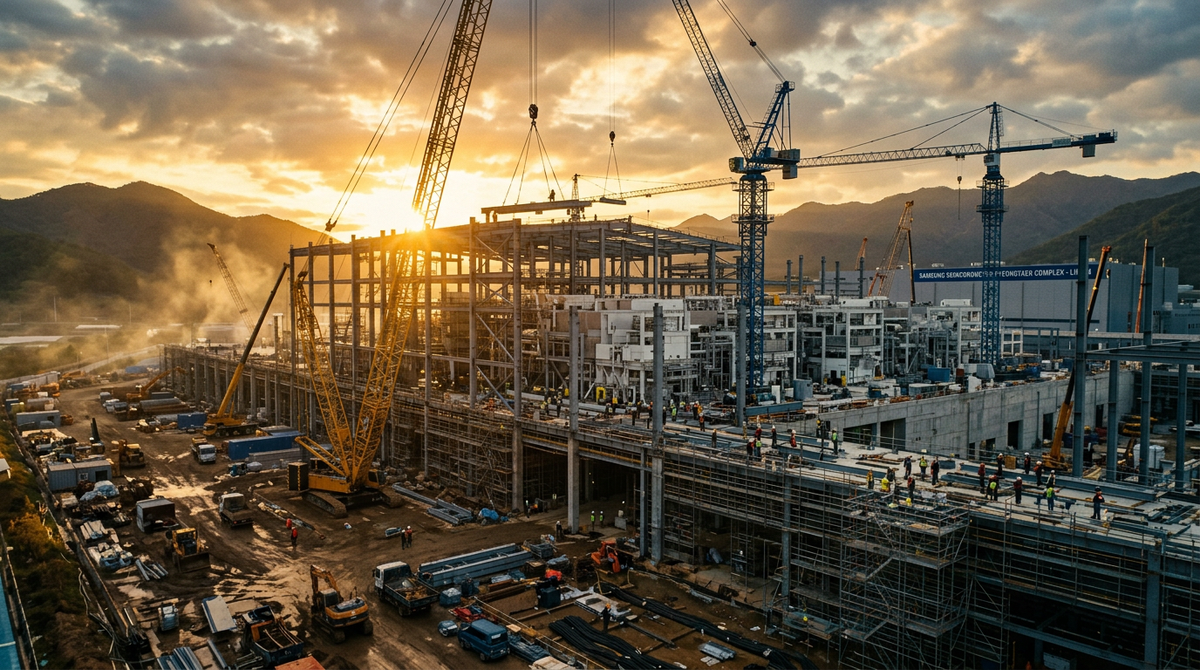
On June 29, 2026, the South Korean government unveiled a sweeping industrial directive alongside leadership from Samsung and SK Hynix. The price tag is staggering: over $576 billion in coordinated semiconductor and artificial intelligence infrastructure spending.
The explicit objective is to lock down absolute global dominance over memory architectures, AI data centers, and autonomous robotics.
The market responded instantly. Equity shares of both Samsung and SK Hynix tumbled immediately following the announcement.
Strip away the noise. These two entities control roughly two-thirds of the global memory chip market. They have just announced the largest joint production buildout in industrial history, and their own institutional shareholders aggressively sold the news.
That signal is not vague. It is a definitive structural verdict.
Capital that has survived prior macroeconomic cycles understands precisely what state-directed mega-projects manufacture. They do not secure geopolitical control; they guarantee a catastrophic global glut.
I. The Anatomy of a State-Directed Capacity Trap
Let the archival record speak without institutional comfort.
Under the unified directive, Samsung and SK Hynix will deploy 800 trillion won—approximately $518 billion—directly through their domestic supply chains to construct four advanced fabrication facilities.
An additional 81 trillion won is allocated toward a specialized packaging hub near Seoul. Concurrently, state-directed infrastructure spending for AI data centers is engineered to reach 550 trillion won by 2029, scaling past 1,000 trillion won by 2035.
The establishment calls this visionary strategy. The fiduciary ledger reveals a capacity trap of historic proportions.
History is an unyielding teacher. Japan’s state-led semiconductor initiatives in the 1980s generated a decade of severe global oversupply. The intervention ultimately crushed the exact domestic champions it was designed to protect.
By 1996, Japan’s global DRAM market share collapsed from over 80% to under 40%. Legacy giants like NEC, Hitachi, and Mitsubishi were forced into dilutive mergers and structural exits.
The playbook remains identical: massive state capital injections, nationalist narrative marketing, and demand projections that assume permanent, straight-line growth within a highly cyclical market.
South Korea’s own corporate history contains the exact same lesson. The 1997–1998 Asian Financial Crisis brutally exposed the structural vulnerability of the debt-reliant chaebol model.
The surviving entities learned that rigid capital discipline entirely supersedes artificial market share expansion. Today, that exact discipline is being discarded at a multi-billion-dollar scale.
The state apparatus has explicitly labeled this initiative the great leap forward. The phrase itself serves as a terminal macroeconomic warning.
Every administrative apparatus that has historicized an industrial policy as a “great leap” has systematically misallocated capital. The terminology does not signal economic prosperity; it marks structural overreach.
The math remains absolute. The domestic mandates require doubling global DRAM production output within five years by artificially accelerating fabrication timelines.
Advanced semiconductor capacity requires two to three years to achieve operational liquidity. If global AI infrastructure demand flattens prior to peak output realization, the structural result is a terminal global supply glut.
The deflationary spiral will be driven entirely by the very monoliths that currently dictate global pricing.
II. The AI Demand Thesis: Forecast Versus Track Record
The entirety of this $576 billion capital allocation rests upon a singular, unhedged assumption: that enterprise demand for specialized AI hardware will expand exponentially without cyclical interruption. The state narrative presumes that demand is a mathematical constant.
This is profound financial blindness dressed as global competitive urgency.
Look at the archival precedents. The telecommunications and fiber-optic buildout of 1997–2001 operated under the exact same structural logic.
The establishment claimed internet bandwidth demand was infinite. Hundreds of billions of dollars in speculative capital were funneled into transoceanic infrastructure.
The long-term direction of the technology was accurate, but the structural timing was catastrophic. By 2002, approximately 97% of deployed fiber-optic infrastructure sat completely dark and unutilized.
Corporate empires like Global Crossing and WorldCom were entirely liquidated. The underlying technology was entirely valid, but capital deployed on the assumption of immediate, linear demand was permanently incinerated.
The contemporary AI chip architecture mimics this precise trajectory. The mainstream narrative insists that hyperscaler data center expenditures can only move upward.
Samsung’s ten-year capital allocation blueprint across fabrication clusters, battery logistics, and AI infrastructure assumes a demand horizon that no institutional analyst can reliably forecast beyond 18 months.
Strip away the narrative. What does the data reveal?
The global surge in AI capital expenditure since 2023 is concentrated within a fragile oligopoly of four technology monoliths. This expenditure does not represent organic market demand. It is an arms race fueled by defensive corporate posture and legacy liquidity.
When corporate borrowing costs remain structurally elevated or a singular hyperscaler pauses infrastructure expansion, the entire demand curve shifts instantly.
This is not theoretical. Meta unilaterally rationalized its AI infrastructure capital expenditures by 40% in late 2022 before reversing course. The macro cycle turns on boardroom liquidity preservation, not state-mandated desires.
The fiduciary reality is stark. Doubling aggregate output does not double top-line revenue; it aggressively decimates operating margins across the entire global memory complex. Every wafer manufactured beyond organic demand destroys enterprise value across the entire global supply chain.
III. The Political Mask Over Capital Waste
A secondary narrative operates beneath the industrial strategy. The state apparatus has explicitly designed this infrastructure plan to narrow regional economic disparities and subsidize provinces outside the industrialized core of Seoul.
Fabrication plants are being directed toward specific southwestern regions, including Gwangju, because they satisfy immediate political objectives rather than logistical optimization.
This is the oldest maneuver in the state-capital playbook.
When central governments dictate manufacturing geography to appease local electorates, operational friction escalates. Displacing specialized labor pools, constructing redundant transit networks, and artificially rerouting complex supply chains introduce structural costs that private market forces would never voluntarily accept.
Historical archives are littered with the wreckage of politically mandated manufacturing hubs. China’s state-directed National IC Industry Fund—the Big Fund—poured over $50 billion into domestic semiconductor localization starting in 2014.
The ultimate result was not global market dominance. It was a compounding wave of localized insolvencies, administrative corruption scandals, and zombie fabrication plants that consumed immense capital while producing obsolete components.
The mainstream media insists that South Korea is insulated from this outcome because its corporate entities are legitimately world-class. The point is entirely irrelevant.
World-class enterprises steered by political mandates into regional development initiatives do not generate world-class returns. They produce structural inefficiency, margin degradation, and long-term shareholder destruction.
The broader $1.3 trillion capital expenditure figure cited across institutional media—representing the comprehensive, decade-long investment horizons of Samsung and SK Group—demands clinical dissection.
This is not unencumbered free cash flow being deployed by private boards. This is highly restrictive, committed capital that must be continuously funded through corporate debt issuance, equity dilution, and state subsidies over a ten-year horizon.
The structural cost of maintaining that funding in a structurally high-rate global environment is a massive, unpriced drag on long-term capital returns.
Global trade rivalries and defensive subsidies do not alter the physics of capital returns. They merely provide ideological cover for unviable private-sector bets.
The math remains absolute. Capital poured into highly cyclical sectors at a peak demand narrative, steered by local political ambitions rather than market forces, builds structural traps.
IV. The Fiduciary Blueprint: What the Carry Unwind Demands
I do not deploy capital based on speculative forecasts. I execute defensive blueprints derived from repeating historical cycles.
The immediate market rejection of South Korea’s $576 billion industrial directive is a direct command to insulate your portfolio from peak-cycle capital destruction.
The historical record demands precise structural adjustments.
First, systematically reduce direct equity exposure to state-subsidized semiconductor stacks. This mandate applies not merely to primary memory manufacturers like Samsung and SK Hynix, but to the entire upstream capital equipment and materials supply chain. These entities will temporarily absorb state liquidity during the construction phase, only to suffer catastrophic valuation adjustments when factory utilization rates inevitably crash.
Second, recognize that the AI narrative is masking deep structural capital destruction across multiple asset classes. AI-focused data center Real Estate Investment Trusts (REITs), thematic semiconductor exchange-traded funds (ETFs), and venture capital vehicles are currently pricing in demand curves that assume permanent, frictionless expansion. The fiber-optic crash of 2001 is not a historical metaphor; it is an exact structural analog.
Third, secure tangible asset allocations immediately. When state capital aggressively floods cyclical industrial sectors, the subsequent margin compression, corporate write-downs, and sovereign debt burdens inevitably ripple through equity indexes and fiat currency valuations.
The assets that successfully survive these multi-decade capital cycles cannot be manufactured, diluted, or manipulated by political mandates. Allocate structurally toward physical gold, productive land, and self-custodied Bitcoin maintained strictly as a sovereign reserve asset entirely outside the legacy banking architecture.
The establishment manufactures narratives. The archive preserves empirical outcomes. Every great leap forward in industrial history has terminated at the exact same coordinates: capital deployed at the peak of structural belief is the capital destroyed first.
South Korea’s semiconductor gamble is not an isolated narrative about technology. It is a textbook manifestation of the eternal conflict between political ambition and the capital cycle. The factories will be constructed. The silicon will be processed.
And when peak national output collides with a cyclical contraction in global enterprise demand, the capital forced into the market at the top will be completely incinerated.
The sovereign asset holder does not participate in state-funded industrial arms races. The sovereign asset holder preserves capital by retreating to high-signal terrain completely detached from political overreach and cyclical ruin.
The macro cycle is not a theory. It is the only constant in markets.
Protect your capital accordingly.
Comments ()