
The ROAD Act Is Law: The Institutional Loopholes Are Already Open

At midnight on July 11, 2026, the United States enacted its most sweeping federal housing legislation in a generation. There were no flashing cameras, no ceremonial pens, and no presidential signature.
The 21st Century ROAD (Reforming Obstacles to Atlas-scale Development) to Housing Act—a massive 381-page bill spanning 12 titles and 60 sections—passed with veto-proof majorities: 85-5 in the Senate and 358-32 in the House. Yet, President Trump refused to sign it. He chose to leave it on his desk as a political protest, attempting to gain leverage for an unrelated voter-ID bill.
He also chose not to veto it. Under Article I, Section 7 of the U.S. Constitution, if a president does not sign or veto a bill within ten days (excluding Sundays) while Congress is in session, it automatically becomes law. The clock simply ran out.
The mainstream press is running dramatic headlines, calling this a “historic triumph for affordability” and a “deadly blow to corporate landlords.”
Let’s strip away the noise and the political theater.
Lately, some readers have rightly complained that geopolitical and financial analysis can get buried under overly complex, academic vocabulary without delivering a clear, actionable point. Let’s fix that today.
This briefing is not a lecture on constitutional law. It is a forensic look at the numbers. The core message of this article is simple: The ROAD Act is a performative crackdown. Its highly publicized “limits” on Wall Street are so full of exceptions that they actually secure, rather than threaten, corporate real estate dominance. If you own residential property or hard assets, your scarcity premium is completely safe.
I. The Constitutional Default: A Shield of Executive Silence
The timeline of this bill tells us everything we need to know about where the real power lies in Washington.
House Speaker Mike Johnson officially delivered the ROAD Act to the White House on June 29, 2026. Because Congress was actively in session, the ten-day constitutional countdown began. By refusing to sign the bill, the President attempted to signal strength to his base on Truth Social.
But because Congress held a massive, bipartisan, veto-proof majority, the White House had exactly zero actual leverage. A veto would have been instantly crushed. The theatrical refusal to sign changed absolutely nothing—not the implementation date, not the terms, and not the regulatory timeline.
For the self-directed investor, the political drama is a sideshow. The reality is that when the bipartisan political class wants to pass legislation that protects institutional capital under the guise of “affordability,” they will bypass executive posturing entirely.
The law is now active. The ledger is now open.
II. The Supply Mirage: Why the 4.7 Million Deficit Remains Untouched
To understand why your real estate assets will retain their value, we must look at the supply-side math. The United States currently faces a housing deficit of approximately 4.7 million homes.
The ROAD Act promises to unleash a wave of new construction. The table below compares what the bill promises on paper against how those programs will actually play out in the real world:
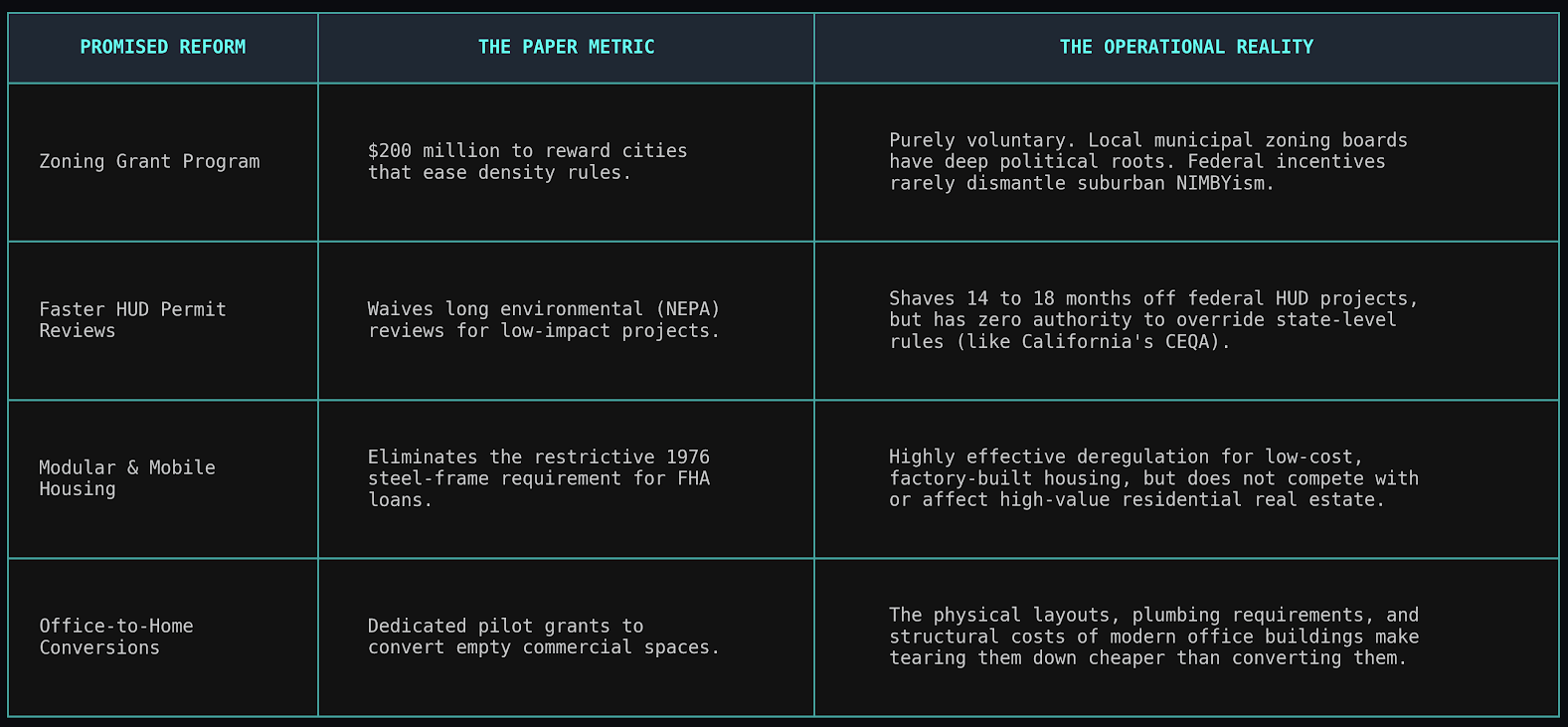
The best-case projection from the Bipartisan Policy Center suggests the ROAD Act might help add roughly 250,000 new housing starts per year, primarily in high-growth, business-friendly states.
At that rate, assuming zero economic recessions, zero supply-chain bottlenecks, and zero credit freezes, it would take nearly twenty years to close the existing housing gap.
The supply of single-family homes is not something you can summon by legislative decree. It requires local labor, raw materials, physical land, and multi-year construction cycles. The scarcity premium baked into well-located residential real estate remains entirely untouched by this bill.
III. The Corporate “Crackdown”: The Exceptions Swallow the Rule
This is the most critical section of the ledger. The media is celebrating Section 1001 of the Act, dramatically titled “Homes Are for People, Not Corporations.”
On paper, the rule sounds devastating to institutional buyers: it completely bars large investors—defined as any entity owning or controlling more than 350 single-family homes—from purchasing additional single-family residential properties. The penalties are fierce: up to $1 million per violation, or three times the purchase price of the home.
The press claims Wall Street is being evicted from the American suburb. The fine print reveals that the corporate housing empire has just been granted a permanent, legally protected monopoly.
Let’s look at the four massive exceptions that completely neutralize the ban:
1. Zero Retroactivity
The law does not require corporate landlords to sell a single home. The massive portfolios owned by institutional giants like Invitation Homes or Progress Residential—numbering tens of thousands of houses—remain completely intact. They are grandfathered in permanently.
2. The Build-to-Rent (BTR) Exemption
The ban applies strictly to buying existing homes. It explicitly exempts the construction of brand-new single-family rental communities.
This is the exact direction corporate capital was already flowing. By exempting Build-to-Rent, Congress has effectively eliminated competition from individual mom-and-pop buyers in the newest sector of the market, giving Wall Street a clear, federally protected run at building entire rental suburbs.
3. The “Renovate-to-Rent” Loophole
A corporate buyer is fully exempt from the ban if they purchase a dilapidated home and spend at least 15% of the purchase price on renovations to bring it up to code. This allows institutional funds to continue vacuuming up cheap, distressed starter homes, shutting out first-time buyers who lack the immediate cash reserves to fund heavy renovations.
4. Exempt Business-to-Business Portfolio Swaps
Large institutional funds are completely permitted to trade existing portfolios of single-family homes among themselves, provided the properties were owned prior to the law’s enactment. The existing supply of corporate-owned housing is now locked in a permanent, institutional closed loop.
The Useful Message: This is not a corporate crackdown. It is a structural reshuffling. The law prevents Wall Street from outbidding regular families on move-in-ready, existing suburban homes, but it actively routes that same institutional capital into building massive, exclusive rental communities and dominating the distressed housing market.
IV. The Fiduciary Blueprint: Positioning Your Capital Stack
When the state drafts 381 pages of new economic rules, your job is not to panic or react to the headlines. Your job is to look at the structural reality and position your wealth accordingly.
If you are managing your own portfolio, the ROAD Act demands three specific, practical moves:
- Maintain Your Residential Real Estate Holdings: Do not let the “corporate ban” headlines scare you into thinking housing prices are going to collapse. The 4.7 million home deficit is a hard, physical fact. The ROAD Act’s supply measures are far too slow, and corporate landlords are not being forced to liquidate. The value of physical land in high-demand, tight-supply metropolitan areas will continue to appreciate.
- Pivot Toward Institutional Channels: If you want exposure to real estate but want to avoid the regulatory noise of single-family homes, look to allocate capital toward the exempt channels created by the law—specifically, developers and private equity funds focused heavily on the Build-to-Rent (BTR) space. That is where the institutional liquidity is heading next.
- Preserve Your Wealth in Invariant Assets: If Congress can rewrite the rules of property ownership overnight, they can rewrite the rules of any paper asset. True capital preservation requires maintaining a solid base of border-neutral, sovereign assets that do not rely on congressional legislation to exist. Physical gold, secured outside the commercial banking system, and Bitcoin held in absolute self-custody, remain the only true exit hatches from a system that excels at writing laws but struggles to build physical infrastructure.
“The establishment celebrates resets. The archive records that every reset in the last century preceded a deeper systemic distortion. The only variable is whether you positioned before the distortion arrived — or after.”
The ROAD Act is a political masterpiece. It allows both political parties to claim they “stood up to Wall Street” ahead of the midterm elections, while ensuring that the actual plumbing of institutional real estate investing remains fully operational.
The housing shortage is real, the currency dilution is continuous, and the regulatory complexity is only growing. Stop trading the performative news cycle. Secure your hard assets, protect your purchasing power, and rely on the math.
The ledger does not lie. Position your capital accordingly.
If this analysis delivered clear, actionable value to your capital framework, consider subscribing to The Fiduciary Archive. Operational macro updates are routed directly to your inbox.
Comments ()