
$40 Trillion: The Debt Milestone That Changes Nothing in Washington and Everything in Your Portfolio

Macro Balance Sheet Audit
$40 Trillion: The Number That Changes Nothing in Washington and Everything in Your Portfolio
The U.S. national debt crossed $40 trillion on August 20, 2026 — five months after hitting $39 trillion, five months before that at $38 trillion. The rate of accumulation is the story. The number itself is just a scoreboard.
The United States Treasury confirmed this week that gross national debt has crossed $40 trillion for the first time in history. The precise figure: $40,047,425,768,420. The milestone arrived ahead of the Congressional Budget Office's own projections. It took just five months to add the last trillion. At that pace, $50 trillion arrives before 2030.
Washington issued a statement. The markets barely moved. CNBC ran a segment. Analysts called it a "milestone." The word "unsustainable" appeared in seventeen separate press releases and meant nothing in any of them.
The $40 trillion number is not the crisis. The crisis is the rate. The U.S. borrowed $1.8 trillion in the first ten months of fiscal year 2026 alone — more than the entire 2025 fiscal year. In July, the government borrowed $14 billion per day. Every single day.
The Archive has been tracking this trajectory since the debt crossed $20 trillion in 2017. It doubled in less than a decade. The investors who understood the structural consequence — not the political theater — acted accordingly. Those who waited for a "debt crisis moment" are still waiting. The crisis is not a moment. It is a process. And it is already operating inside your portfolio right now.
This briefing delivers the forensic mechanics of what a $40 trillion debt load actually does to purchasing power, bond yields, and the dollar. The core message is unambiguous: a government that borrows $14 billion per day to service existing obligations is not managing fiscal policy — it is running a structural debasement program. The only rational response is to own assets the Treasury cannot print.
I.The Debt Mechanics: What $40 Trillion Actually Does to Your Money
The press covers the debt as a political story. It is a mechanical one. Here is the exact six-step transmission from the Treasury's borrowing to the erosion of your retirement purchasing power:
1.The Treasury issues new bonds to finance the deficit. As supply of government paper increases, buyers demand higher yields to absorb the volume. The 10-year Treasury yield rises — not because the economy is strong, but because the borrower is less credible.
2.Interest payments on existing debt now exceed $1.1 trillion annually — more than the Pentagon budget, more than Medicare. The 2025 fiscal year marked the first time debt service costs exceeded national defense spending. Interest has now become the second-largest line item in the federal budget, behind Social Security.
3.Higher government borrowing competes directly with private sector borrowing. Corporate bonds, mortgages, and small business loans all reprice upward. The cost of capital across the entire economy rises — not because of Fed policy, but because of Treasury supply pressure.
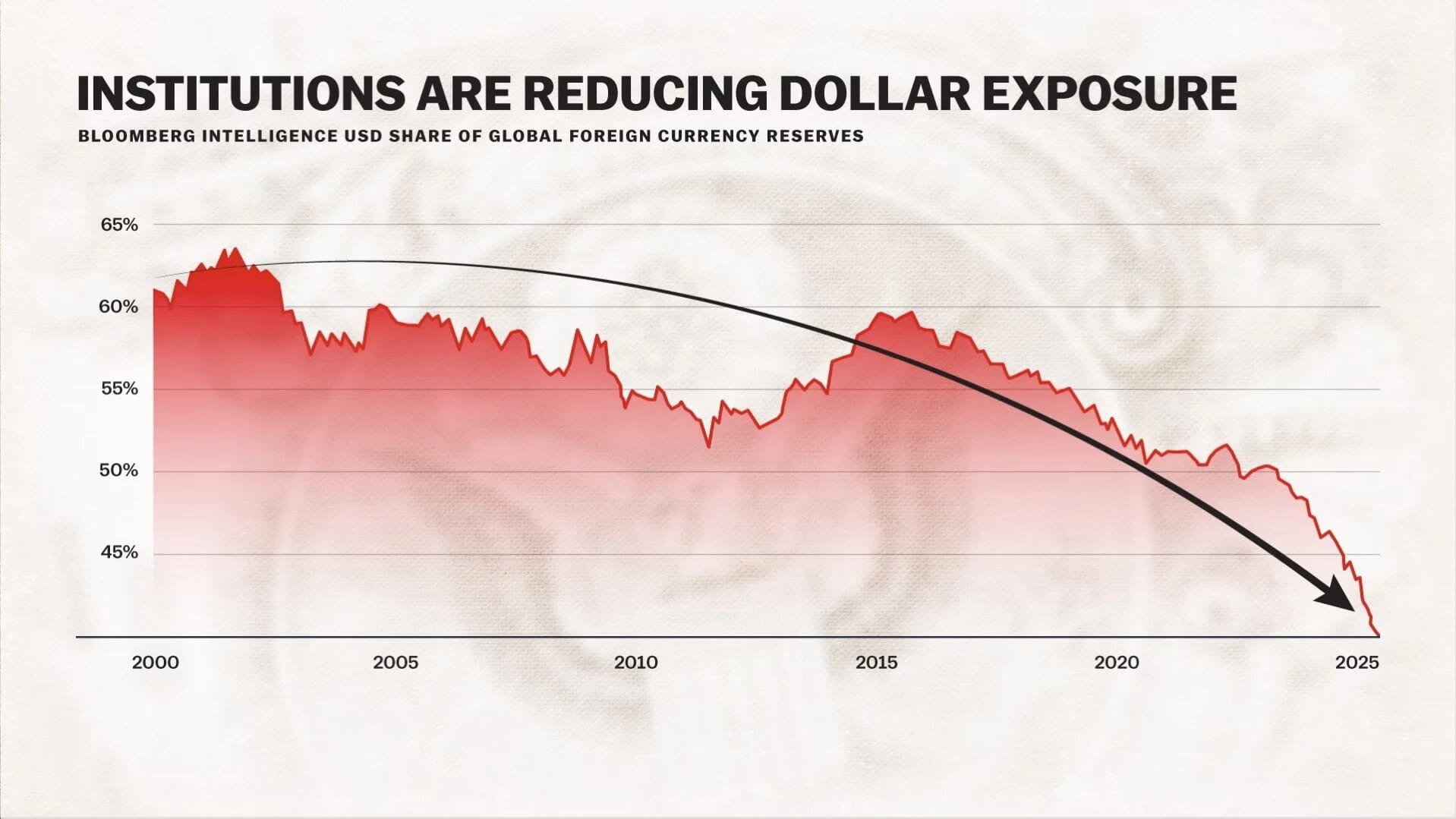
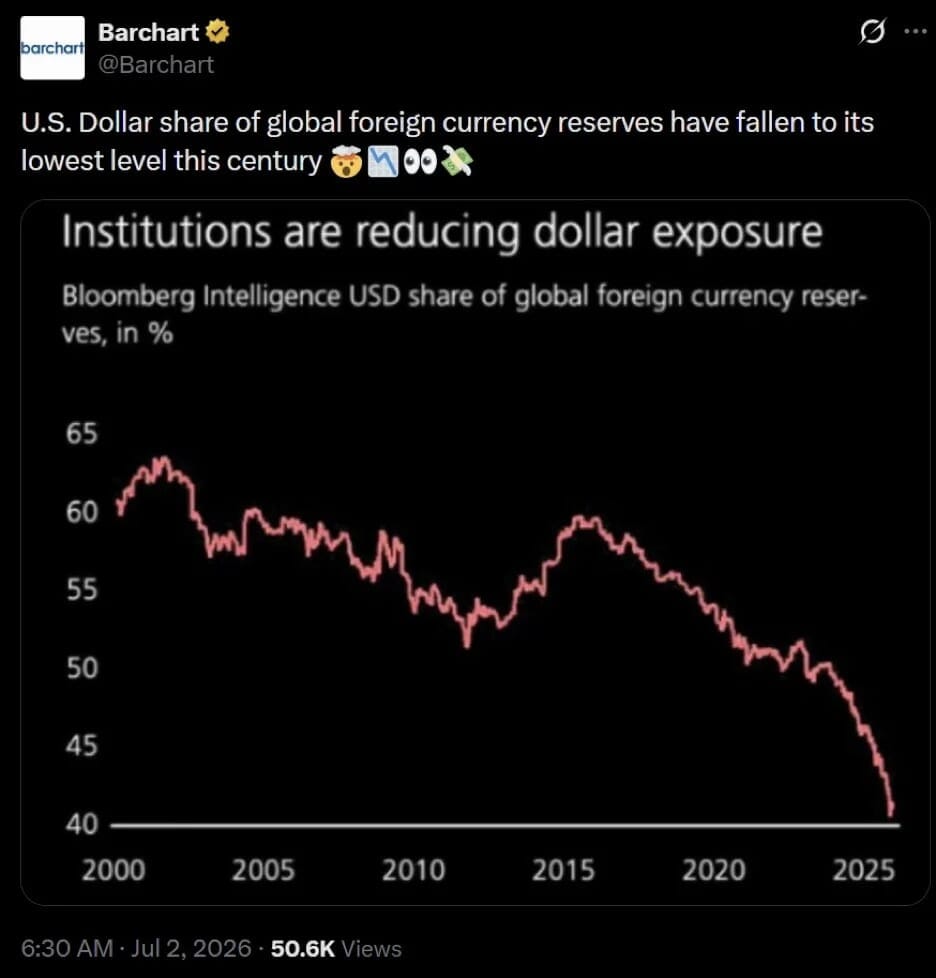
4.Foreign holders of U.S. Treasuries — China, Japan, the Gulf states — reassess their allocations under accelerating de-dollarization pressure. Reduced foreign demand for U.S. paper forces the Fed to monetize a larger share of Treasury issuance, expanding the money supply and embedding additional inflation.
5.The dollar's purchasing power erodes structurally. Not in a single crisis event — but daily, invisibly, through the mechanism of excess money supply relative to productive output. The retail saver holding cash or low-yield fixed income loses purchasing power without a single market crash occurring.
6.Hard assets — physical gold, productive land, commodities — reprice upward in dollar terms to reflect the reduced purchasing power of the unit of measurement. The investor holding these assets does not "make money." They preserve purchasing power while everything measured in dollars inflates around them.
| The $40 Trillion Debt Ledger | Treasury Audit |
|
Gross national debt as of Aug 20, 2026 |
$40.05 trillion |
|
Daily borrowing rate July 2026 |
$14 billion per day |
|
Annual interest cost on existing debt |
$1.1 trillion — exceeds Pentagon |
|
Debt-to-GDP ratio 2026 |
101% — first time since WWII |
|
CBO projection debt-to-GDP by 2036 |
120% — above 1946 WWII peak |
| *The Useful Message: The debt doubled from $20 trillion to $40 trillion in less than ten years. At current trajectory, $50 trillion arrives before 2030. The CBO's own baseline has debt exceeding 120% of GDP by 2036 — a level the U.S. has never sustained in peacetime. There is no historical precedent for this trajectory resolving without a significant debasement of the currency. | |
Fiduciary Recommendation — Ad
|

II.Forensic Dissection: The Milestone That Changes Nothing in Policy and Everything in Reality
The Bait
Congress and the White House issue statements acknowledging the milestone. Fiscal hawks demand spending cuts. The administration points to economic growth projections. Both sides agree the debt is "a problem." Markets interpret the political acknowledgment as a signal that the situation is being managed. Bond yields hold. The dollar holds. Nothing changes.
The Friction
The CBO estimates the Trump administration's One Big Beautiful Bill will add $4.2 trillion to the debt through 2034. Interest costs have already surpassed Medicare spending to become the second-largest budget line item. Public debt held by outside creditors has exceeded GDP for the first time since 1946 — the year the U.S. demobilized from World War II. There is no legislative majority for structural spending reduction. There is no political appetite for meaningful tax increases. The debt does not have a resolution path. It has a continuation path.
The Extraction
Governments with no political resolution to structural debt have three historical options: default, austerity, or inflation. The United States will not default on dollar-denominated debt it can print. It will not implement austerity that ends political careers. The third option — allowing inflation to gradually erode the real value of the debt — is the only one compatible with the current political structure. It does not require a vote. It does not require an announcement. It simply requires the Treasury to keep issuing and the Fed to keep accommodating. The investor holding cash and fixed income pays the bill. The investor holding hard assets does not.
III.The Historical Precedent: Every Nation That Reached 100% Debt-to-GDP in Peacetime
The Archive contains the resolution record of every major sovereign that crossed the 100% debt-to-GDP threshold in peacetime during the modern era. The playbook is remarkably consistent across different governments, currencies, and political systems:
1946 — Post-War United States: Debt-to-GDP peaked at 106% after wartime spending. The resolution was not austerity — it was two decades of above-average inflation combined with strong postwar growth. The dollar lost approximately 50% of its purchasing power between 1946 and 1966. Gold, fixed by Bretton Woods at $35/oz, represented the only monetary anchor. When Nixon ended Bretton Woods in 1971, gold repriced from $35 to $800 within a decade.
1990s — Japan: Japan crossed 100% debt-to-GDP in the late 1990s following its asset bubble collapse. Three decades later, Japanese debt stands at 260% of GDP. The resolution has been permanent financial repression — near-zero interest rates, central bank monetization of government paper, and a yen that has lost 40% of its value against hard assets since 2020 alone. Japanese investors who held physical gold in yen terms preserved their purchasing power completely.
2026 — The United States: Public debt now exceeds GDP for the first time since 1946. The CBO projects it reaching 120% by 2036. Unlike 1946, there is no postwar growth boom to inflate away the debt organically. Unlike Japan, the dollar is the global reserve currency — meaning the inflationary consequence of U.S. debt monetization exports itself across every dollar-denominated asset held worldwide. The Archive notes this distinction with particular concern.
"Every government that has faced this arithmetic has eventually chosen the same resolution: inflate the debt away. They do not announce it. They do not vote on it. They simply continue to spend more than they collect, allow the central bank to absorb the excess paper, and let time and rising prices do the accounting. The investor who understands this does not panic. He simply moves to the other side of the ledger."
Julian's Ledger Note — Ad
|
IV.The Sovereign Blueprint: Five Moves Before $50 Trillion
The debt will not trigger a dramatic crisis on a single Tuesday. It will continue its current process — daily, structurally, invisibly. The investor who acts before $50 trillion acts before the next inflation cycle prices in the additional debasement. Here is the actionable blueprint:
01.Move Core Reserves Into Physical Gold — Not Paper Gold
GLD, gold ETFs, and mining stocks are paper claims on gold that exist within the DTCC clearinghouse infrastructure — the same system that depends on the same Treasury paper creating the debasement pressure. Allocated physical bullion held in private storage outside the commercial banking system is the only gold exposure that performs its function when the underlying debasement process accelerates. Target 15–20% of investable capital as a structural floor, not a speculative position.
02.Eliminate Long-Duration Treasuries From Your Portfolio Immediately
Holding 20- or 30-year Treasury bonds when the issuer is borrowing $14 billion per day and debt-to-GDP is at 101% and rising is the definition of a structurally mispriced asset. Long-duration Treasuries performed in low-inflation environments. The current environment is not low-inflation. Rotate any long-duration fixed income into sub-90-day Treasury bills or Series I Savings Bonds with inflation adjustment built in.
03.Measure Every Portfolio Return in Gold Ounces — Not Dollars
When the unit of measurement is debasing, nominal returns are misleading by design. Divide your total portfolio value by the current gold price in ounces. Track that number quarterly. If your portfolio is growing in gold-ounce terms, you are preserving purchasing power. If it is shrinking in gold-ounce terms, you are losing real wealth regardless of what your brokerage statement says in dollar terms. This single reframe eliminates the most common capital destruction error of the debt cycle.
04.Add Productive Land as a Non-Financialized Hard Asset
Agricultural and timber land held debt-free carries no counterparty risk, generates productive output that reprices with inflation, and has no correlation to equity market volatility. The Boston families the Archive has studied across generations have maintained 10–15% of total wealth in productive land through every debt cycle, every inflation episode, and every currency debasement since the 1800s. The strategy is not complicated. It is simply old enough that the financial industry has no commission structure to promote it.
05.Establish Legal Jurisdictional Structures Before the Debt Forces Political Solutions
Governments facing structural debt crises have historically implemented wealth levies, retirement account restructuring, capital controls, and exit taxes as political pressure mounts. These measures are never announced in advance — they arrive with immediate legal effect. The window to legally structure private capital across asset-friendly jurisdictions is open now, before fiscal pressure produces legislative urgency. International asset protection trusts, second residencies, and foreign-domiciled legal entities are not conspiracy — they are the standard operating architecture of every family office managing generational wealth through sovereign debt cycles.
The debt crossed $40 trillion on August 20, 2026. It will cross $41 trillion before the year ends. The press will cover each milestone with diminishing alarm and increasing normalization. The investor who waits for the crisis announcement will wait until the purchasing power destruction is already complete. The Archive does not wait. It positions.
THE MATH REMAINS ABSOLUTE.